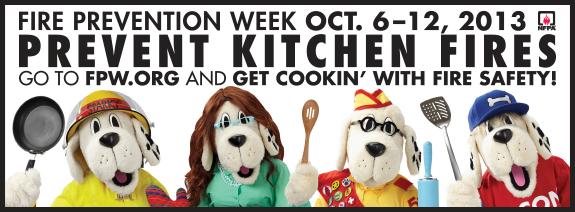
| "Prevent Kitchen Fires"—that's the message of this year's Fire Prevention Week
From October 6-12, we'll be spreading the word that more fires start in the kitchen than in any other part of the home—and we'll help teach people how to keep cooking fires from starting in the first place.
"Reproduced from NFPA's Fire Prevention Week website, www.firepreventionweek.org. ©2013 NFPA."
Home Fires
In 2011, U.S. fire departments responded to 370,000 home structure fires. These fires caused 13,910 civilian injuries, 2,520 civilian deaths, $6.9 billion in direct damage.
On average, seven people die in U.S. home fires per day.
Cooking is the leading cause home fires and home fire injuries, followed heating equipment. Smoking is a leading cause of civilian home fire deaths.
Most fatal fires kill one or two people. In 2011, 12 home fires killed five or more people resulting in a total of 67 deaths.
Cooking
U.S. Fire Departments responded to an estimated annual average of 156,600 cooking-related fires between 2007-2011, resulting in 400 civilian deaths, 5,080 civilian injuries and $853 million in direct damage.
Two of every five home fires start in the kitchen.
Unattended cooking was a factor in 34% of reported home cooking fires.
Two-thirds of home cooking fires started with ignition of food or other cooking materials.
Ranges accounted for the 58% of home cooking fire incidents. Ovens accounted for 16%.
Children under five face a higher risk of non-fire burns associated with cooking than being burned in a cooking fire.
Microwave ovens are one of the leading home products associated with scald burn injuries not related to fires. Nearly half (44%) of the microwave oven injuries seen at emergency rooms in 2011 were scald burns.
Clothing was the item first ignited in less than 1% of home cooking fires, but these incidents accounted for 16% of the cooking fire deaths.
Heating
The leading factor contributing to heating equipment fires was failure to clean, principally creosote from solid fueled heating equipment, primarily chimneys.
Portable or fixed space heaters, including wood stoves, were involved in one-third (32%) of home heating fires and four out of five (80%) home heating deaths.
Half of home heating fire deaths resulted from fires caused by heating equipment too close to things that can burn, such as upholstered furniture, clothing, mattresses or bedding.
In most years, heating is the second leading cause of home fires, fire deaths, and fire injuries. Fixed or portable space heaters are involved in about 4 out of 5 heating fire deaths.
Smoking Materials
During 2007-2011 smoking materials caused an estimated 17,900 home structure fires, resulting in 580 deaths, 1,280 injuries and $509 million in direct property damage, per year.
Sleep was a factor in one-third of the home smoking material fire deaths.
Possible alcohol impairment was a factor in one in five of home smoking fire deaths.
In recent years, Canada and the United States have required that all cigarettes sold must be “fire safe,” that is have reduced ignition strength and less likely to start fires.
Electrical
About half (49%) of home electrical fires involved electrical distribution or lighting equipment. Other leading types of equipment were washer or dryer, fan, portable or stationary space heater, air conditioning equipment water heater and range.
Electrical failure or malfunctions caused an average of almost 50,000 home fires per year, resulting in roughly 450 deaths and $1.5 billion in direct property damage.
Candles
During 2007-2011 candles caused 3% of home fires, 4% of home fire deaths, 7% of home fire injuries and 6% of direct property damage from home fires.
On average, there are 32 home candle fires reported per day.
Roughly one-third of these fires started in the bedroom; however, the candle industry found that only 13% of candle users burn candles in the bedroom most often.
More than half of all candle fires start when things that can burn are too close to the candle.
Escape Planning
According to an NFPA survey, only one-third of Americans have both developed and practiced a home fire escape plan.
Almost three-quarters of Americans do have an escape plan; however, more than half never practiced it .
One-third of Americans households who made and estimate they thought they would have at least 6 minutes before a fire in their home would become life threatening. The time available is often less. And only 8% said their first thought on hearing a smoke alarm would be to get out!
Smoke Alarms
Almost two-thirds (62%) of reported home fire deaths resulted from fires in homes with no smoke alarms or no working smoke alarms.
Working smoke alarms cut the risk of dying in reported home fires in half.
In fires considered large enough to activate the smoke alarm, hardwired alarms operated 92% of the time, while battery powered alarms operated only 77% of the time. |